The Bible Standard - Discover the Truth.
Christadelphians Talk about various subjects concerning True Bible Teaching.
Listen on:





Episodes
Thursday Jul 10, 2025
Thursday Jul 10, 2025
1Samuel 24 verse 7 tells of David and his men hiding in the wilderness of En Gedi - which means "the eye of the fountain",, or "the eye of the wild goat" - where Saul was pursuing him. Saul went into a cave to release himself. David's men urge him to slay Saul as it seemed to them that God had delivered David's enemy into his hand. David tells his men that he cannot innocently lift his hand against the LORD's anointed. David stealthily enters the cave and cuts off the corner of Saul's robe. After this he was ashamed that he had done this. Verses 8-15 speak of David calling after the king from a safe distance and relating to Saul what has happened. David says that there is no way that he would have killed Saul and the proof was in David's hand. He claims that Saul was pursuing an insignificant flea. David claims that Yahweh will vindicate his righteous behaviour. Verses 16-22 reveals Saul's pathetic response to David's plea and an acknowledgment of David's faithfulness and a declaration that God will continue to bless David for this reason. Saul says that he is sure that the Almighty will bring David to the throne. King Saul asks David not to retaliate against his family when David reigns. David swears an oath to Saul to that effect.
We are in the first chapter of Jeremiah introduced to one of Yahweh's long suffering prophets. Jeremiah commenced his prophecy in the year BC 628 as a young man related to king Josiah who was nearing the end of his short reign. Jeremiah continued his ministry beyond BC 588 when Jerusalem fell to Babylonian king Nebuchadnezzar. Jeremiah was the son of Hilkiah the priest (in all likelihood the High Priest) and therefore cousin to king Josiah. His ministry within Judah lasted from the end of Josiah's reign (occasioned by his untimely death in battle with Pharaoh Necho) until the dissolution of the kingdom under the faithless and vacillating Zedekiah. Jeremiah played a central role in the unparalleled reforms of Josiah and was himself devastated by the premature removal of the king he loved. He was foreknown of God and chosen before his birth to be a prophet to plead with God's people to reform and also to the surrounding nations - a task which, as youth, he found daunting. Nevertheless he was strengthened to perform this in the face of persistent and hostile opposition.
In Matthew 12 we have two incidents, both deliberately performed on the Sabbath day, illustrating that Jesus was indeed the Lord of the Sabbath, in contrast to the Sabbath having authority over our Lord Jesus. The first of these confrontations between the Pharisees and Jesus' disciples was whether the disciples had the right to pluck and eat the ears of grain ( Jesus cites the precedent in David's eating of the shewbread, which our readings from two days ago highlighted). The second incident was the healing of the man with the withered hand. In all likelihood the Pharisees had planted this man at the front of the synagogue in Capernaum as a challenge to our Lord. Would he heal on the Sabbath day, or not? This healing proved that our Lord Jesus Christ was Yahweh's chosen Servant of Isaiah 42. These incidents are followed by grievous charges being leveled against Jesus of doing miracles by the power of Beelzebul - the lord of the dung heap - the prince of the demons. Jesus claims that this charge amounted to blasphemy against God's power which was being flagrantly denied despite incontestable evidence that Jesus was from God. Then follows the lesson of the fruits. Our Lord Jesus declares that the type of tree we are is shown by the fruits - ie actions of our lives - Jesus kindly words, actions and healings proved that he was the Son of God. And their hatred, words and enmity towards our Lord illustrates that they were acting from minds that were carnal in every respect. Our Lord would advance further incontestable proof of his Sonship with a prophecy of his resurrection from the dead as the sign of Jonah - the prophet from Galilee (see John 7:50-52). The chapter concludes with the parable of the unclean spirit seeking a lodging place. It leaves its abode and starts to look for another house. But finding no place it returned to its original home and found it to be swept clean. The spirit then found another 7 vile creatures to return and take possession of the original house. This spoke of John the Baptist and our Lord Jesus Christ purging the house of Israel. Only for the foul priests and Pharisees uniting to kill our Lord Jesus Christ: Matthew 23 verses :19-39. Lastly the chapter records that Jesus' own family sought to 'rescue' him from the trouble he had seemingly caused. His family were not impressed with his head on confrontations with the nation's religious leaders. Perhaps they believed he needed rest and time to reflect on a better course of action and not antagonise Israel's leaders. Jesus tells his family that he is doing the work of his God and that those who choose to listen to his Father's Word are his true family.
Wednesday Jul 09, 2025
Wednesday Jul 09, 2025
After relocating from his hiding place David and his men go to Keilah a fortified town where they had a right to believe that they would be safe. This is because on following instructions from God to go to Keilah and David having rescued the inhabitants of Keilah from the Philistines David rightly expected loyalty from them. In verses 6-14 Saul hears of David's "foolishness" and brings his army to Keilah. David consults God's advice and is told to flee from Keilah as the ungrateful townsfolk would hand him over to Saul. David and his men fled to the wilderness of Ziph where Saul daily sought him; but the LORD protected him. Verses 15-18 tell us that yet again Jonathan is able to find David and encourage him to continue to trust Yahweh who will bring David to the throne. Another covenant is made between the two great friends. Verses 19-29 tell of the Ziphites' treachery in betraying David by telling Saul where David was hiding. When Saul had completely surrounded David and his men a message came to Saul telling him that the Philistines had attacked Israel and Saul must come to protect his people. Yet again we see how the Almighty's providence saved David. Let us put our trust in our Sovereign who will always use His power to preserve His people for His kingdom. Psalms 17 and 54 were most likely written to thank God for His deliverance.
Isaiah 66 verses1-2 tell of the greatness of our Omnipotent Creator and His requirement for His children to show Him the reverence that is due to Him. His Word is powerful and the faithful must tremble before God's Word. Interestingly the sect of the Quakers used Isaiah 66 verse 2 as the foundation clause of their beliefs. The sense of the Hebrew of verse 2 that Yahweh is actively seeking worshippers who are similar to Himself: compare Isaiah 57 verse 15. Our God, despite His Majestic Grandeur, is of a humble disposition and can only be worshipped by humble people: James 4 verses 7-10; 1 Peter 5 verses 5-7. Verses 3-4 describe God's detesting of the nation's hypocrisy and formalism in Israel's worship. Verse 5 tells the faithful to patiently endure despite what they had suffered for their choosing God's ways. Verse 6 says that God will vindicate His people and repay their enemies. Verses 7-14 speak of the LORD's blessings on His people at the time of His Son's kingdom. God's first people Israel will become the focus of the worship of the Almighty during the kingdom: Isaiah 2 verses 1-5; Jeremiah 3 verses 16-17; Zechariah chapters 8, 13 and 14. The reborn nation will be centred in Mount Zion. This nation will spring into existence from the time of their acceptance of the Lord Jesus Christ as their Messiah: Romans 11 verses 15-36; Galatians 4 verses 21-31. This will be a time of great joy and gladness. Verses 15-23 speak of the final glories of the Creator being brought to fulfilment in the earth. The commencing of this process is a time of severe judgment against the world and its abominations. Verses 18-20 describe some nations receiving more favourable treatment during this time than others and those who have shown favour to Israel will receive mercy from the LORD according to His promise to Abraham in Genesis 12:1-3. After Armageddon these nations will assist in the bringing of Jewish people to their homeland. And from among the returning Jews our God will make some of them mortal priests in the Land. Slowly read verses 22-23 aloud and let your mind contemplate the glory of that time when all flesh shall worship Yahweh in the glory of holiness. Verses 24 concludes the prophecy with the total eradication of the wicked.
Matthew 11:1-6 tells us that John the Baptist sent some of his disciples to Jesus from his prison at Machaerus to Jesus asking whether our Lord was the Messiah. Some have seen this as John wavering under an intense trial. I doubt this as John knew from the time of Jesus' baptism that Jesus was Messiah: John 1:29. It would seem that John knew that he had run his race and finished his course. More than likely he was sending his disciples to transfer their allegiance to Christ. Verses 7-19 give our Lord's response to, firstly John's disciples, but more so to the bulk of the wondering crowd who were fickle in their views about John. Jesus tells the crowd that John was resolute - John was not a reed shaken by the wind. Our Lord tells them that John followed his divinely appointed mission without being affected by the refinements of the great people of his time. He was Yahweh's messenger who was the forerunner of the Messiah - the messenger of the covenant: Malachi 3:1-4; Luke 1:67-80. There was no greater man born of a human mother than John the Baptist - excepting Jesus himself. Since Jesus' mission in proclaiming the good news of the kingdom, men and women are exerting themselves to put the kingdom first. John was the last representative of the era of the Law and the Prophets that prophesied of Messiah. Jesus was the beginning of the era of grace and truth: John 1:1-18. Verses 16-19 speak of the crowd's fickleness. They were like the children in the marketplace who when their friends said "we want to play funerals" their friends replied "no we want to play weddings". God in his wisdom had sent them John the Baptist and lastly His beloved Son. The bulk of the crown responded to neither man's beseeching of them. Was Jesus work independent of John's work without avail and unwise? No! Both Jesus and John the Baptist were needed and their missions were complementary to the work of each other. Verses 20-24 record our Lord's denouncing of the unrepentant cities of Galilee - Capernaum, Chorazin and Bethsaida - they had witnessed many miracles and heard the wonderful message of Jesus the Son of God; and yet had failed to repent. Jesus says that Tyre and Sidon would have turned to God had those cities been presented with the works done among the Galilean peoples. Those cities were shown much but showed little response. Their inhabitants will be judged accordingly. Likewise, says our Lord Jesus, that Sodom would have responded better than these two cities in Galilee did. So they will be held responsible for their rejection of the Son of God. In verses 25-27 Jesus offers a prayer of thanksgiving to his Father for revealing His will to the lowly and humble people and hiding it from the self important and proud people who think themselves to be somebodies. In verses 28-30 Jesus appeals to his listeners to yoke themselves together with him. Jesus speaks to all who are burdened in words that remind us of Isaiah 55:1-4. Each of us need the Lord Jesus to help us to bare the load each of us must carry: see also Galatians 6:1-10. When our Lord bares our burden our burden becomes lighter. Like his Father our Lord Jesus is kind and humble and in that understanding we can find rest. In verse 30 his yoke is described as "easy" and the Greek word means 'kindly'. It tells us that in joining with Christ there will be great benefits and kindness experienced. Let us learn this and walk in harmony with our Lord Jesus towards his kingdom. For at that time he will finally bring us into his rest: see Hebrews chapters 3 and 4.
Tuesday Jul 08, 2025
Tuesday Jul 08, 2025
The incidents in these two chapters reveal David at a low point in his life. They reveal his despair and exasperation which were to cost the lives of those associated with David. David has fled from Saul in fear of his life and the lives of the men who are with him. David's first thoughts are of food and a weapon to protect himself. He goes to Nob to the high priest - Ahimelech - seeking sustenance and a sword. David's trust should have been in his God. In Yahweh he would have found provision - as Israel had for 40 years in the wilderness - and he would have found protection. The high priest was fearful at David's arrival. So many throughout Israel knew of Saul's envy of David. To help David will be extremely dangerous. Yet Ahimelech also knew that Yahweh was with David. David commences on a course of deception that will be his pattern for years. Once you start lying it will become a habit that will be hard to break. David requests the shewbread which had just been changed that Sabbath day: Luke 6 verses 1-4. Verse 7 of 1 Samuel 21 notes, almost as an aside, that Doeg was there and that he was a chief cattle herder of king Saul. Doeg was a vile and violent Edomite as chapter 22 records. Verse 8-9 tell us that Ahimelech gave Goliath's sword to David. David received it with great anticipation not knowing the grief that the possession of this sword would cause him. Verses 10-15 speak of David's folly in fleeing to Gath with the sword of the giant champion - Goliath of Gath. David's fame proceeds him and his folly exposes him to great danger. David is brought into the presence of Achish king of Gath to explain what he is doing in Gath. In terror David feigned madness but also silently prayed intensely for his God's rescuing of him. Other accounts tell us that David was imprisoned in Gath, but later inexplicably released. The reason David was released is told us in Psalm 34 - recording his prayer in his extremity and from that what he would teach to his band of men: Psalm 34 verses 1-22. Slowly read these words aloud and contemplate the lessons for each of us. That Psalm, due to the vital lessons it teaches, is one of the most frequently quoted Psalms in the New Testament.: eg 1 Peter 3 verses :8-17. 1 Samuel 22 speaks of the snowballing consequences of lying. Verses 1-5 tell us that David fled from Gath to the cave of Adullam where he first sought to educate his followers in the need for truth and trusting in the Almighty. Next he arranged for the rescuing of his mother and father who were sent to Moab and remain there whilst David was a fugitive. Many people who felt oppressed by Saul's ways fled and came to David for leadership, protection and security. David would do this for them and more as he would guide theme in the way of Yahweh their Sovereign. The prophet Gad urged David to flee from Adullam. Verses 6-8 tell of Saul appealing to the Benjaminites, his own tribe, to betray David. Saul says that he will enrich his tribesmen and that David would not do this. The Benjaminites are reluctant despite being offered a bribe to betray David. Verses 9-10 describe Doeg's enthusiasm to tell Saul of Ahimelech's support of David. Verses 11-19 tell of the high priest being interrogated by Saul; his being sentenced to death for supposed treachery. We are told of the reluctance of Saul's soldiers to slay the priests and Doeg's single handed slaying of 85 priests at Nob. In addition Doeg slew the women, children and livestock of the town. Verses 20-23 speak of Abiathar's escape and his relating the incident to David, who offers him asylum.
Isaiah 65 verses 1-7 tells us of God's lament at the unholiness of His people who refuse to obey His voice. Israel commit every imaginable abomination despite the LORD's continual pleadings with them. They were like an irritating smoke in God's nostrils. Yahweh cannot be ignored without consequences. The Almighty will punish them for their contempt towards Him. Verses 8-10 present a contrast with the attitude of the majority. The remnants of the LORD's people - His servants - will experience abundance of blessings from Him. Even the curse that Achan brought upon the nation of Israel when he took from the devoted things of Jericho will be reversed. The valley where he was buried will become an oasis for sheep and as the prophecy of Hosea says - 2 verses 15 - will become "a door of hope" (Hebrew' Peta Tikva' the words of Israel's national anthem composed in 1882). There is always hope for those who wholeheartedly turn to the LORD: Joel 2 verses13-14. Verses 11-12 describe the punishments that Yahweh would bring upon His people. Verses 13-16 also contrast God's obedient servants with His disobedient nation. When Yahweh blesses His servants those rebels will experience want. Our Omnipotent Creator promises that the time will come when those who are blessed acknowledge that their blessings come from the "God of Truth" - Hebrew' Eduth here translated as "Amen". Verses 17-25 talk of the blessings of the kingdom age under the rule of Jesus Christ the Messiah. Verses 17-19 are quoted in 2 Peter 3 verses 11-13. Peter says we are looking for God to fulfill His promise to the faithful. The new heavens and earth speak of the administration of Christ's kingdom. Note how Revelation 21 verses1-5 speaks of a change of government and although this vision is of the time after the millennium the figure still stands that the heavens relate to rulership and the earth to those peoples who are subject to the heavens: see also Deuteronomy 32 verses1; Isaiah 1 verses 2,10. Verses 20-25 describe the longevity which will prevail during the millennium - 1,000 year - reign of our Lord Jesus Christ. Mortality still exist, but life will be prolonged so that one dying at one hundred years of age will be considered to be but a child. However the persistent sinner dying at 100 years will still be considered to be cursed. There will be a harmonious relationship between animals commencing in Mount Zion and eventually throughout the entire world: Isaiah 9 verses 1-7; 11 verses 6-9. This is also symbolic of the peace between the nations of the earth. But this is only possible under the government of our Lord Jesus Christ. Isaiah 65 verse 25 reminds us that the curse from Adam and Eve's disobedience in Eden has been rolled back when we are told that the serpent - snake - will still eat dust. The blessings apply to productive farming and long occupancy of houses because the wicked have been restrained. How this contrasts greatly with what we see in our world in this troubled age.
Matthew 10 verses 1-4 tell of our Lord Jesus' selection of his 12 Apostles. Their mission is described and their names given. In verses 5-15 they are sent forth with a commission to preach solely to "the lost sheep of the house of Israel". Mark 16:15-16 tell us that the Lord's ambassadors after his resurrection were to be sent into all the nations of the known world. The Apostles' message was to repent because the kingdom was at hand. Accompanying miracles were to be done to demonstrate that the work was from God. A failure to respond to the preaching was to be met with a curse upon those refusing the invitation from the Almighty through His Son and His Son's emissaries. Verses 16-25 tell us that those carrying the good news - ie the gospel - could expect to receive persecution just as Jesus their Master was experiencing. In verses 26-33 Jesus says to those Apostles that they must preach without any fear of human authorities as they could only take away their life until God would resurrect His faithful witnesses. Jesus' witnesses must not put their light under a bushel: Matthew 5 verses 14-16. The same remains true today. Although we are respectful of human government our allegiance is to our Sovereign Omnipotent Creator: 1 Peter 4:1-11. Verses 34-39 teach us that in our witness for Christ we will often find that this proclamation will bring division within families. We must not be overzealous in pushing our message upon anybody including our family; and we need to be kind in the way we present our views to them. We need individually to pick up our stake and deny ourselves in following our Lord Jesus Christ. In so doing we will in the kingdom receive the blessings of the faithful. Verses 40-42 tell of the blessings for showing kindness now - even in the smallest of ways.
Tuesday Jul 08, 2025
Tuesday Jul 08, 2025
It's amazing that Saul with spies everywhere could not find David in the wilderness yet Jonathan on his own could find him. No! It's not amazing as God was protecting David and assisting Jonathan in finding him. And preventing Saul from finding David. The discussion between David and Jonathan indicates that David had only been absent from Saul's regal table for a matter of days, or at most weeks. They make a plan to explain David's absence and to find out how Saul will react to this news. Together Jonathan and David devise a scheme to communicate Saul's mood without exposing David to danger. The two friends make a covenant twice sworn because of their mutual love. Jonathan will pretend to shoot at a target outside of the city and will either tell David by sign that it will be safe to come back to the palace, or for David to flee swiftly. Saul says nothing to reveal his mood on David's first absence believing David to be ceremonially unclean. But in an uncontrollable rage Saul throws a javelin to kill his son Jonathan. Saul claims that David and Jonathan have conspired against him and that Jonathan's mother is to be blamed for Jonathan's weakness. Jonathan left Saul's feast in a rage and he the next morning warns David to flee with haste.
Isaiah 64 verses 1-4 is a call from the prophet for a theophany - God revealing, or manifesting, Himself - to His people. The language recalls the time in Exodus 20 when God came down on Mount Sinai in might and power and gave His people a "fiery Law": Habbakuk 3 verses 1-16. The earth trembles at His majestic and awesome presence. The purpose of manifesting His power is that His people will respond with respect and trust for their Sovereign. Verse 4 tells of the LORD's love for His people and the wonders He has in store for them: 1 Corinthians 2 verses 6-16 explains Yahweh's purpose for His children. It is to fill the earth with His glory revealed in His glorious children. Verse 5-7 is a lament that speaks of our best efforts to please the Almighty. These are pitiful and unbecoming no matter how hard we try. However when we graciously accept His forgiveness and mercy and trust in His righteousness we become children who delight our God. Verses 9-12 is a prayer for our Omnipotent Sovereign to reverse our desolation and bring peace and glory to Zion when He delivers us.
Matthew 9 verses1-8 speak of our Lord Jesus Christ healing a paralytic man. Note our Lord's love, compassion and authority all shown in this miracle. Jesus demonstrates the link between sin and sickness. Adam's sin brought suffering, sickness and death. Jesus' life and offering brought deliverance from these: Jesus Christ is the Lord of life. And his life caused men and women to glorify God. In verses 9-13 Jesus called Matthew, ie Levi, to follow him. Many murmured that Jesus would ask a tax collector to become one of his disciple. Our Lord responds by quoting the words of Hosea 6:6 to explain why he ministers to the needy and not the self righteous. In verses 14-17 Jesus responds to a question about fasting by saying that his disciples were not fasting while the bridegroom was with them. The disciples of our Lord were like supple wineskins who were able to grow with his teaching rather than being stifled by adherence to mere tradition. Verses 18-26 speak of Jesus' restoration to life of Jairus' daughter. Jairus was the ruler of the Capernaum synagogue. This miracle again proves that Jesus is "the Lord of life". Just prior to restoring life to Jairus' daughter Jesus heals the woman with the issue of blood. The unnamed woman could not be cured by any of Israel's doctors. Our Lord did what the Law and its rigid followers were incapable of doing. In verses 27-31 Jesus heals two blind men. What he requires of them is faith that he can heal: not only physical disease but more importantly sin. In verses 32-34 our Lord cures a deaf man. This is a reminder of Messiah's kingdom rule: Isaiah 35 verses 1-10. Read slowly aloud and pause and ponder. Verses 35-38 tell of our Lord's mission and motive. Why did he heal? Because God had anointed him to do so: Isaiah 61:1-4; and because he came to open the blind eyes: Isaiah 9:1-7. What moved him to so act - zeal for His God and compassion for God's children: Matthew 9 verses36; Numbers 27 verses17. The great volume of work moved our Lord Jesus to say Jesus: Pray for God to send more labourers into His plentiful harvest.
Sunday Jul 06, 2025
Sunday Jul 06, 2025
1Samuel 19 speaks of king Saul's plotting to kill David. When Jonathan hears of this he refuses to believe that his father, Saul, would do this to faithful David. Jonathan is able to temporarily dissuade his father from carrying through Saul's intent to destroy David. Jonathan brings about a period of respite between Saul and his son-in-law. Verses 8-10 speak of another battle between Israel and the Philistines. Saul again moved with envy cast his javelin to slay David. David escapes and flees from Saul's presence. Verses 11-17 describe David as a fugitive in his own house, where Saul believes David has been trapped. David and Michal plan David's escaping from the city and her placing pillows of goats' hair in David's bed and covering them to pretend that David is sick in his bed. Saul commands his soldiers to bring David to him in his bed that Saul might slay David. Michal lies to her father saying that David threatened to kill her. David flees to Samuel in Ramah. Both Samuel and David anticipate Saul's wrath and take refuge in Naioth. Saul hears of this and comes with his army to destroy David. Saul had sent two armed contingents before coming himself. But each of these groups including the king himself were prevented from apprehending David by God's spirit coming on them and causing them to prophesy. It became a perplexing proverb: "Is Saul also among the prophets?"
Isaiah 63 is about the day of Yahweh's vengeance and the remembrance of His mercy. Verses 1-6 speak of a period of time after the Lord Jesus Christ's return to earth. This period is described in Revelation 10 as the March of the rainbowed angel. The time is after the invasion of Israel by the northern confederacy. Jesus and his saints will go into the ancient region of Edom to subdue and convert the Arab peoples into accepting Israeli Jews fleeing from the foe that has conquered their land and is systematically imprisoning Jews. Our Lord Jesus has his clothing of a red colour being stained with the blood of his enemies. He makes war in righteousness with his foes. The figure of warfare here and in Joel 3:13 is likened to the crushing of grapes in a winepress. Verse 4 tells us that the vengeance of our God is for a day, but His mercy and redemption is for a year. His wrath is limited but His grace and mercy is abundant: Exodus 34 verses :5-7; Psalm 103 verses 1-19; James 3 verses 12-13. Verse 5 tells us that our Lord Jesus only the Saviour empowered by His Father. And so our Lord is righteous in the exercise of his judgment. Verses 7-14 tell of Yahweh's remembrance of His mercy to His people Israel. Verses 7-9 recount the evidence of the Almighty's exercising His redeeming mercy when He delivered His people from Egypt. Verses 10-14 say that despite His love they constantly rebelled throughout their wilderness wanderings. Despite the grief that this caused their Father. Yet despite this He brought them through the Red Sea and into the Land promised to their faithful patriarchal fathers and through this gained renown and a famous Name: Yahweh. Verses 15-19 is a prayer of the prophet for Israel's Sovereign to again show mercy to His people. His stedfast love and compassion will compel the LORD to deliver His children. Israel had been disciplined for their waywardness but will be won over by the love of their Father and will be brought home from exile to be Yahweh's people.
In Matthew 8 verses 1-4 Jesus cures a leper. This chapter shows Jesus' authority in both word and deed. The leper knew Jesus had the power to heal. The only question was: "Would Jesus heal him?" Our Lord cured the leper and sent him to the priests to testify that Jesus could do what the Law couldn't do: Romans 8 verses1-6. Verses 5-13 speak of the faith of a Roman centurion. He asked the Lord Jesus Christ to heal his servant. The Roman asked Jesus to simply speak the word and the servant was to be healed. Verse 5 says that the centurion, being a man commanded by Rome, saw Jesus as the empowered servant of God - Jesus' Father through whom salvation comes - and with divine power and authority to heal. Our Lord Jesus said that this type of faith exceeds that of the nation who claimed to be God's children. Jesus declares in verses 10-13 that such faith showed that man to be a true son of Abraham. The Lord's words are reminiscent of the promise that God made to Abraham in Genesis 13 verses 14-16. By contrast the lack of faith of the chosen people would see them excluded from gaining the benefits of the Abrahamic promise. Verses 14-17 describe many miracles fulfilling the words of Isaiah 53 verses 3-4. Verses 18-22 tell disciples that the cost of following the Lord Jesus Christ is to forsake all other pursuits now and start that following of Jesus immediately. Verses 23-27 tell of Jesus' authority over the elements of nature in calming a storm. The cures he performs show him to be the Son of God who can save life. Verses 28-34 describe the curing of two demented men. We need to have our minds healed from the madness that is endemic in human nature and only our Lord and his Father can do that. We will be partially cured now as we heed the words of life and completely cured when by God's grace we are given an immortal body incapable of sinning.Thoughts on the Bible Readings
Saturday Jul 05, 2025
Saturday Jul 05, 2025
1 Samuel 18 speaks of David's deep friendship with Jonathan - Saul's son - his appointment to high office in Saul's army; and of David's marriage to Michal - Saul's younger daughter. Verses 1-5 tell of the strong bond that was forged between Jonathan and David following the victory of faith which had allowed David to slay Goliath the giant of Gath. The two friends - David and Jonathan - were one in their attitude towards their God. Let's highly prize and value true friendships as these can assist us in walking faithfully towards the kingdom of God. Jonathan made a covenant with David and gave to David his bow - which was Jonathan's prized weapon of choice - and the royal robe which he wore. Saul retained David as one of his army captains. Verses 6-9 describe Saul's envy of David who was praised by the Israeli women above Saul their king. David was under Saul's watchful and critical eye. Saul believed that David was seeking to usurp him. Verses 10-16 describe a foul mood overtaking Saul and his unsuccessful attempt to kill David with the king's javelin. The LORD's protection surrounded David. David's behaviour caused Saul to be in awe of David. In verses 17-31 Saul, knowing of the love of David for Saul's younger daughter Michal, seeks to have David slain in battle by the Philistines by asking a dowry from David of two hundred foreskins of the Philistines. What treachery to use a ruse of vengeance against God's enemies as an excuse to eliminate the king's rival. Likewise how wonderful it is when our lives bare testimony to our being the children of our Heavenly Father.
Isaiah 62 describes Zion's coming salvation. Verses 1-5 speak of the prophet's prayer for his beloved Jerusalem. It is a prayer for her destiny to be delivered by her faithful and Almighty Sovereign. Jerusalem will be a city of truth and righteousness as Zechariah 8 verses14-23 speaks. The terms used in verses 4-5 describing the fruitfulness of the land are used of Hezekiah and his wife Hephzibah. In verses 6-7 the prophet asks all the faithful to copy their faithful king who despite settling watchmen on Jerusalem's walls he continues to pray and trust in the Almighty and counsels his people to do likewise. Verses 8-9 tell of his confidence in the LORD to deliver and exalt His people during the glorious reign of His Son in the near future. Verses 10-12 describe the time when Yahweh elevates Zion to the capital of the world: Isaiah 2:1-5; Jeremiah 3 verses 16-17. The people of the LORD will be blessed and all nations will come to Jerusalem to worship in sincerity and truth.
The judgment mentioned in Matthew 7 verses 1-5 refers to critical fault finding in others as opposed to the need to show discernment . We must judge righteous judgment: we are commanded to do so. Verse 6 tells disciples to not share the precious knowledge of God with mockers who will never change. Verses 7-11 tells us that the askers will receive; the seekers will find; and to the knockers doors will be opened. This is because our Heavenly Father is faithful to His promises and will only give good gifts to His children. In verse 12 our Lord highlights the golden rule - do to others what you would wish them to do for you. Verses 13-14 tell us to strive to please God. Diligence must characterise the disciple's life. Without diligence we will easily lose our way. Verses 15-20 teach us what type of tree we are; for the fruits of our lives will be seen in the fruits of our behaviour. Verses 21-23 are sobering thoughts which teach us that is not what we say that will save us - but rather how we live. Our Lord only knows those who understand him and love and live as he lived: There was a popular song many years ago called: "To know him (Jesus) is to love him". Our Lord Jesus knows those who love him and he reciprocates that love to them. Matthew 25 verses 34-36. Read aloud and pause and ponder. Verses 24-27 tell of two builders - one wise, the other foolish - each one chose a different foundation on which to build. The wise man undertook the long and laborious task of digging deep and founding his house on the rock: Matthew 16 verses 13-20; 1 Corinthians 3:10-17. The foolish builder lazily chose the quick and easy way of building on sand. When the waters and tempests and afflictions of trials tested the stability of the structures, the houses, house on the rock stood firm, but the house on the sand was swept away. The Lord Jesus Christ says that wisdom lies in listening to his words and acting on them. Only doers of the Word and not simply forgetful hearers are founded upon the rock: James 1:19-27. Verses 28-29 speak of Jesus' authority in his speech in contrast to the scribes who quoted each other rather than speak with a "Thus says the Word of God".
Friday Jul 04, 2025
Friday Jul 04, 2025
A @Christadelphians Video: **📝 Video Description:** **✨ A revealing deep dive into Jesus’ most beloved parable—the Prodigal Son (Luke 15:11-32).** In this thought-provoking talk, John Martin explores the younger brother’s rebellion, the father’s radical forgiveness, and the older brother’s struggle with grace. Discover how this ancient story speaks directly to our lives today. **🔔 Love Bible teachings like this? Subscribe + click the bell to receive notifications for new videos!** **📜 Key Bible Verses (Emoji-Categorized):** 🕊️ **Luke 15:11-32** – The Prodigal Son’s Journey 🐑 **Luke 15:1-10** – The Lost Sheep & Lost Coin 💖 **Romans 2:4** – God’s Kindness Leads to Repentance ✝️ **1 John 1:9** – Confession & Forgiveness **⏳ Full Chapter Timestamps (56-Minute Breakdown):** 00:00 – Introduction** (Why This Parable Matters) 06:15 – Part 1: The Younger Brother’s Rebellion** (Leaving Home) 14:30 – Part 2: Consequences of Sin** (Hitting Rock Bottom) 22:45 – Part 3: The Turning Point** (True Repentance) 30:10 – Part 4: The Father’s Unconditional Love** (Running to Restore) 38:25 – Part 5: The Older Brother’s Resentment** (Grace vs. Legalism) 46:50 – Part 6: Modern Applications** (How This Story Changes Us) 53:20 – Conclusion & Final Reflection** **📌 Tags:** Bible study, John Martin, Life of Christ, Prodigal Son, Luke 15, Parables of Jesus, Christian teaching, Gospel message, Repentance, Forgiveness, God's love, Lost Brother, Grace, Biblical wisdom **💬 Discussion Prompt:** *"Do you relate more to the younger brother, the father, or the older brother? Let’s discuss in the comments!"*
Friday Jul 04, 2025
Friday Jul 04, 2025
In all 3 readings the contrast between perception and reality is shown to be a mighty chasm, which fleshly thinking invariably gets wrong every time.
There are 3 words in the Hebrew for man: the most frequently used'Adam' (the man of dust); secondly 'Enosh' (sick mortal, weak,frail man); and lastly, 'Ish' (mighty man, man of renown'). All 3 are used in 1 Samuel 17 - the warriors of Israel are the third word(so is Jesse), as is the Philistine 'champion' (Goliath). The third word predominates the chapter until David speaks of Goliath as an Adam (v32). Saul answered David by referring to the colossus as the Ish he seemingly projected. David's rejoinder to Saul indicated Yahweh's ever present aid and deliverance for David from the lion and the bear and assured the king that the uncovenanted Philistine would be equally dispatched. The victory being assured because "the living God" was in heaven and His Israel on earth. The Almighty's beloved servant prevailed with sling and stone and carried the severed head to Jerusalem where Gog's multitude will likewise in the near future be carcasses on the ground (Ezekiel 39). Psalms commemorative of this victory and penned by David indicate what his motivations and thoughts were in Psalm 8. The Hebrew superscription to this Psalm is "Muth Laben" indicating on 'the death of the Champion', an alternative translation of the Hebrew is "on the death of the victorious son", ie our Lord Jesus Christ. Jesus is the Adam to whom the Almighty would give the dominion planned for the Adam at Creation. This Adam would be given the dominion over all flesh: Genesis 1:26; Psalm 8. This is what the Apostle Paul is talking of when he speaks of "the all things" LXX 'ta panta' in Colossians 1. This particularly speaks of the slaying of the enslaver of the race; the undefeated Champion over every single person until our Lord Jesus Christ, the Son of Man' came triumphantly: Colossians 2:9-15. Also the entire 144th Psalm tells us the same. It tells us that although both David and our Lord Jesus knew the frailty of their estate Yahweh of armies would prevail over flesh and "the Adam" would eventually conquer sin and death.
Isaiah 61 tells of Yahweh's blessing and favour to Zion through the LORD sending His beloved Son to them promising them restoration and healing through Messiah, his gospel message and restoration and healing through the offering of himself. The early verses are cited by our Lord Jesus in his home town synagogue in Nazareth - Luke 4 verse 16:30 - where he declared "today is this Scripture fulfilled in your ears". He has only quoted to the first half of verse 2 since Jesus ministry was to offer hope to the repentant who embraced the gospel message. The "day of vengeance" would come upon those who rejected the message in 70 AD (to the Jews) and the entire world at Jesus' second coming. This earned the ire of the townsfolk where our Lord had grown up in their midst and worked in their midst. The people of Nazareth attempted to kill him by casting him from the precipice. It was this Scripture that sustained John the Baptist as he languished in the prison (Machaerus) of Herod Antipas. Verses 3-7 describe the blessings which will flow to Zion when Jesus Messiah reigns over them at the appointed time. Verses 8-9 tell of their Sovereign's call on Israel to turn from their hypocritical ways and embrace the paths of the LORD. All the world will then acknowledge that nation as the blessed children of God. Verses 10-11 tell of the prophet rejoicing in the Almighty Creator and His plan to bring righteousness and blessing to the entire earth.
In Matthew 6 Jesus warns against 3 forms of showy piety prevalent amongst the Pharisees of his day: conspicuous giving of alms (charity, prayers designed to impress others rather than heartfelt requests to the Father and attention-seeking fasting. Matthew 6 verses 1-6 points out that charitable deeds must have their focus on the receiver and not the giver - and the reward being future not present. The same attitude must characterise our prayers: verses 5-6. Jesus then provides a model prayer in which the reverence of God and His Name - Yahweh our Father - being foremost. Then His Kingdom sought when His will is done. Next petition for needs (not wants), the forgiveness of our sins (measured and determined of our Father by our capacity to forgive others) and then deliverance from "the evil" - ie our nature's provocation within us to sin. Verses 16-18 advises on fasting: a preparation of the mind to serve God, not an opportunity to impress others with our religious dedication. Verses 19-24 tell us that the heart is a magnet. What we treasure most will be measured by what occupies our thinking most. Don't pretend we are serving God when our minds (hearts) are preoccupied with ourselves - ie covetousness which is idolatry (Colossians 3verses 5). Verses 25-34 speak of the treasure we should seek: freedom from all anxiety is known by our God who loves us and will provide all that we need to bring us into His Kingdom. Our Father has shown us His majesty and power to bestow blessings and beauty through His creative acts. The last two verses of the chapter establish what must be the primary purpose of our lives: honouring our Father and His Son by setting our affection on things above. Slowly read these aloud. Pause and ponder. One day at a time, the Father has given us. We leave the worry for tomorrow to Him.
Thursday Jul 03, 2025
Thursday Jul 03, 2025
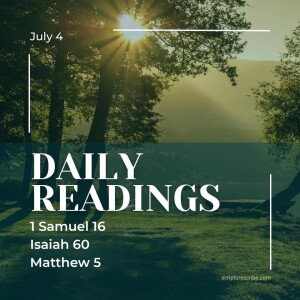
God sent Samuel to Bethlehem to anoint a replacement for Saul, the failure who sat on the throne, from among Jesse's sons. The elders of the town trembled after hearing of Samuel's summary dispatch of Agag and asked him if he had come in peace. He replied, 'yes'. One by one the seven older brothers pass before him - each one impressive in his features; only for Samuel to be told not to look on the outward appearance (the basis of human judgment), but rather on the heart, which is Yahweh's basis of measurement. At last the youngest, who was not thought worthy of being presented, was brought, chosen and anointed. David was invited to soothe Saul's melancholic moods by playing his harp.
Isaiah in chapter 60 the time of Zion's future glory, when the wealth of the nations will pour into her (Psalm 102 verses12-22). Verses 1-3 describe the LORD bringing glory from gloom to the long downtrodden nation of Israel. We are living close to the commencement of that epoch as our above quote from Psalm 102 reveals for Yahweh has restored Israel to their homeland. He has once more given them Jerusalem. Verses 4-9 tell of the flowing of the wealth of the nations into Zion. We are told that many Arab nations will be to the forefront of helping Zion, as will Great Britain through her navy. The maritime power of Tarshish (Britain) will be at the forefront of Zion's restoration. Verses 10-14 speak of the prominence that Israel will experience and those who afflicted her will coming begging for mercy. Verses 15-16 is an acknowledgment of the Almighty's role in Jerusalem's elevation. Verses 17-22 outline the abundance of blessings that will flow to her as she is blessed in Messiah's kingdom. Just as in Revelation 21 Jerusalem's glory will be the LORD God Almighty and his radiant Son.
Matthew 5-7 is called "the sermon on the mount". Note from the start that after an arduous climb away from the multitude Jesus prepared a series of talks designed for disciples. It begins with a composite picture of our Lord's own character as the blueprint for all true citizens of Zion. There are 8 beatitudes: verses 2-12 - and the reward for each is the same- just expressed in different terms- that is to be blessed with a place in Messiah's kingdom. The 8 blessings - beatitudes- find their antitheses in the curses, or woes upon the Scribes and Pharisees in Matthew 23. Within the 8th blessing (Greek "kairos" - a happiness borne in the knowledge of our Father's overriding love and care for His children) there is a ninth, for those who then heard and were moved to respond to the gracious words which they heard. Verses 13-6 give 2 metaphors which describe the disciple's purpose - to shine forth the gospel to others - and who the disciple truly is - a sincere follower of our Lord Jesus Christ. Verses 17-20 tell us of Christ's mission and as his followers our duty to develop a righteousness of the heart and not one of outward appearance to others. Verses 21-26 tell us to control anger and to reconcile problems, not stir up strife. Verses 27-32 deal with lust and difficulties within marriage. Verses 33-37 ask disciples to tell the truth and avoid oaths. Verses 38-42 ask us to avoid retaliation. Verses 43-48 instruct us to be as our Father and show love at all times. We note in all these words the authority of our Lord: "but I say unto you". This contrasts with the Jewish leaders who would quote one or another rabbinical authority: Matthew 7:28. In all of these segments our Lord goes beyond what the Law requires and goes straight to the issues of the heart. Let us also learn that this is how we should look at the Word of God and the words of His Son. The fifth chapter concludes with an appeal for the Father's children to appreciate and emulate His character (verses 43-48).
Wednesday Jul 02, 2025
Wednesday Jul 02, 2025
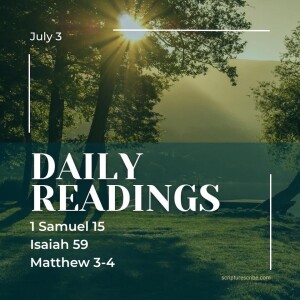
In Exodus 17 verses15-16 Yahweh declares that a banner would be lifted up proclaiming perpetual war against Amalek, since they had continued to snipe at Israel from the time of their departure from Egypt. Psalm 105 verse 37 indicated that when Israel left Egypt they were emboldened and triumphant; but as the Exodus reading indicated became disheartened by the guerrilla tactics of Amalek. Consequently Saul is given a charge by God to eradicate Amalek. This Saul did with horrendous results failing to complete what the LORD commanded. This failure led to God’s promising to take the kingdom from Saul. Saul justifies this failure by rationalisation. That is always a disastrous course. God castigates Saul through the prophet Samuel’s denunciation from his Sovereign. Pause and slowly read aloud the classic words of verses 22-23. Meditate its meaning for us. We do well to note that the failure to exterminate Amalek cost Israel dearly in the past (Haman was an Agagite Esther 3:1 – compare Baalam’s prophecy Numbers 24 verse 7, and 20 verses 7-10, Ezekiel 38verse 2, 16-18 39 verses 1-16, Revelation 20 verses 7-10) and Gog will in the future invade Israel. Gogue is derived from Agag. Samuel provides Saul with a salutary lesson.
Isaiah 59 verses1-13 outline Israel’s incorrigible behaviour, and by extension all possessing human nature, thus bringing inevitable judgment. The metaphors that are used graphically illustrate Israel’s inability to escape from the dilemma with which they were trapped by their passions – and by extension every human being. Verses 14-20 describe how their Sovereign would firstly judge and then redeem mankind. We give thanks to our God and Yahweh’s arm, strengthened and extended, to bring us the sinless Saviour Jesus – who overcame sin and established a basis for our forgiveness. The Almighty has provided for us a standing with our Omnipotent Creator through the forgiveness of our sins. We become the Almighty’s grateful children. Verse 20 is cited in Acts 3 verse 26. Read the last seven verses in Acts 3 and contemplate their importance to you. Verse 21 reveals that Yahweh has not only brought us to Himself, but He also continues to support us daily through His spirit Word. This will be with us throughout all time until His Son returns: Hebrews 13 verses 5-8.
Matthew 3 presents Jesus as the Messiah, totally compliant to the Father’s righteous requirement acknowledging human nature to be rightly related to death and our God’s gracious forgiveness and offer of resurrection to eternal life to those identifying with our Lord’s sacrifice by submitting to baptism (Romans 6). Verses 1-6 tell of the message, appearance and mission of John the Baptist. John commenced his preaching with the Gospel message from Isaiah 40. Verses 7-10 tell of the rulers’ hypocritical response to John and his scathing denunciation of them. He speaks of the divine judgment that was to be brought upon them and their nation. Verses 11-12 he says that the Messiah will come to complete God’s mission: Malachi 3 verses1-5. Verses 13-17 describe Jesus’ baptism and His Father’s testimony approving His Son by word and sign.In chapter 4 Matthew shows the Son of God triumphant over temptation through the sustaining power inherent in God’s Word. The Lord Jesus was tempted in all points like his brethren, as Hebrews 4 verses 14-16 and 1 John 2 verses 15-17 reveal. Genesis 3 shows each of the same elements of temptation of Adam and Eve as 1 John outlined. But unlike Adam and Eve’s temptations our Lord’s came, as Mark 1 tells, surrounded by now savage beasts; and in a cursed wilderness – not a wonderful paradise (garden). Jesus was assailed in all the categories of sin with which we are assaulted. But unlike us he emerged from the temptations triumphant having overcome by his faith in the Word of his Father. Jesus’ divine begettal gave him a mind capable of being totally immersed in his Father’s empowering Word. Thus arming him adequately for the sore temptations with which he struggled. All his answers were from Deuteronomy 6 and 8 demonstrating that he had learned the lessons of trial during 40 days in the wilderness. Israel failed to learn these wilderness lessons during their 40 years within their journey to the Promised Land as Hebrews 3 and 4 teaches us. The chapter finishes with the great work in Messiah’s Galilean ministry, as prophesied in Isaiah 9:1-2.