The Bible Standard - Discover the Truth.
Christadelphians Talk about various subjects concerning True Bible Teaching.
Listen on:





Episodes
Tuesday Feb 04, 2025
Tuesday Feb 04, 2025
In Exodus 11 the 10th and final plague is announced to Israel, who Moses commands that they borrow (take spoil) from their Egyptian neighbours. The totally traumatised Egyptians gave plentifully in the hope that Israel would leave peacefully, and that their God would bring no more plagues upon Egypt. At midnight, said Moses, the firstborn from every unatoned forhousehold would be killed. Pharaoh would remain hard hearted and unresponsive until that disaster came; in order that Yahweh's power might be magnified to all the earth.Exodus 12 tells of the details and observance of Yahweh's Passover. It was commenced, being kept at 3pm on the 14th day of Abib - which at the time God ordained be celebrated as the first, or beginning month of the year. The LORD had rearranged Israel's calendar. This date commemorates Israel's birth as a nation - their beginnings. The chapter also tells of death to anyone who fails to hear and respond in obedience to the Word of our Sovereign (Egyptian and Israelite alike) - note how frequently the expression "cut off" is repeated in the record. The chapter emphasises that this deliverance was tied in with the fulfilment of the promises made by God to Abraham. Another inescapable connection was that circumcision was an essential part of the Almighty's covenant with His people, Israel. Every detail of the Passover ceremony was a shadow type of the atoning work of our Father, which was fulfilled in the offering of our Lord Jesus Christ. The purity of the Lamb spoke of the sinless life of Jesus(1 Peter 1 verses 17-25). The poured out blood - an acknowledgment of our need for an atoning offering(Hebrews 9 verses 12-22). The placing of the blood on the doorposts and lintel - an acknowledgment that only within the house of Christ is there deliverance and salvation. The manner of the eating - in a state of preparedness and expectation(1 Peter 1 verses13-16). As sojourners we eat the LORD's Passover with staff in hand and having girded up the loins of our minds with truth. The angel that, at midnight, brought death upon Egypt also brought deliverance for God's chosen people. In grief Pharaoh sent Moses the message to hasten and leave the land of Egypt. The Egyptians urged the Israelites to depart with great gifts (the LORD declared these to their rightful wages from their enforced slavery). The time of Israel's departure coincided precisely "to the day" of which God had told Abraham - verses 40-42 the time difference being reconciled as the the time God spoke with Abraham and the start of Abraham's seed being afflicted30 years later(Genesis 15 verses 13-15). The family of Jacob went into Egypt as 70 people. They came out as the nation of Israel - as the hosts of Yahweh - a mixed congregation of 600,000 men beside women and children(possibly two million, or more).
Psalm 66 is a writing which celebrates the awesome deeds of the Almighty. God's foes would cower before His might. Now as the Kingdom has come (which verses 3-4 tell of) that would praise the Creator, who caused these wonders. The psalmist invites his readers to behold God's accomplishments. Verse 6 recounted Yahweh's mighty acts on behalf of His people in the preparing the way through the depths of the Red Sea. The writer then tells of how his experiences of the LORD's acts on his behalf. The Psalmist must have experienced some pursuit by enemies as he speaks of his desire to, and confidence that, he would worship again in his Sovereign's sanctuary. The vows that had been made, whilst being persecuted, would now be performed. In conclusion his Creator is praised for His faithfulness and the reader exhorted to praise Him.Psalm 67 gives, as did the former Psalm, instructions to the choirmaster. The Psalm tells of God's gracious face shining on His people. It was a prayer that the nations may through experience know of, and respond to, the LORD's salvation. All peoples and nations would praise their King, and tell to all their hearers, of the exaltation of earth's Omnipotent Sovereign. When this happens the earth will bring forth in abundance and all nations will be blessed.
In Mark 1 we have the beginning of the Gospel of the Son of God. There is no introduction, nor genealogy, for Jesus is depicted as Yahweh's servant. Jesus' ministry commences at his baptism when Jesus is about 30 years old. Mark next records our Lord's forty days of temptation in the wilderness. Mark alone tells us that the wild beasts were with him in the wilderness. Mark uses the expression "Immediately" many times in the first chapter and is a key word in Mark's record. The events described follow "immediately" after our Lord's testing. At the start of Jesus' ministry he calls his first Apostles. The chapter then tells us about the healing of a man with an unclean spirit. We are next told that there was a vast number of unrecorded miracles. That is followed by a preaching campaign in Galilee and the healing of a leper, whose plight deeply and personally touched our Lord and evoked from him his great compassion. This leper was sent to the priest as a testimony that the Son of God had come, and would do what the Law could not.
Monday Feb 03, 2025
Monday Feb 03, 2025
Exodus 10 records plagues 8 and 9 – the ravenous grasshoppers (plague locusts) and the intense supernatural darkness, which gripped every Egyptian household. Israel has been learning of what Yahweh’s Name meant personally to them. Remember that God has severed His people from the Egyptians from plague 4 onwards. Well might they say what the Psalmist recorded (27 verse 1), “The LORD is my light and my salvation, whom shall I fear” (ESV). Note that the record in Exodus 10 verses 23 shows that the Israelites were given light from their Deliverer. After the 8th plague Pharaoh’s nobles pleaded with him to give in to the God of Israel before Moses, as His representative, totally destroyed Egypt. Pharaoh proposed a compromise by allowing the adult males opportunity to sacrifice. Moses said, No: everyone must be allowed to leave. Moses and Aaron were forcibly driven from Pharaoh’s presence. This stubbornness from Pharaoh resulted in Moses, invoking Yahweh’s might, bringing the most devastating and ravenous locusts ever seen in Egypt. Pharaoh hastily summoned the LORD’s envoys telling them that he was sorry for his mistake. The locusts were taken away, but Israel’s Sovereign knew the king’s response would be to harden his heart once Pharaoh had been given remission. The plague of unnatural darkness followed entirely enveloping every Egyptian household for 3 days and producing terror. Pharaoh, once again, calls for Moses and Aaron and tells them that all the people can go, but the livestock must stay. Not so, says Moses, we must bring our offerings with us. Pharaoh would not hear any of this and told Moses and Aaron to leave and never come back – if you see me again it will be your death sentence.
Psalm 64 is from David’s pen. In it he asks his Sovereign to hide him from his foes and be his Deliverer. Those who plotted his destruction and used their bitter words as arrows would themselves be destroyed by Yahweh’s arrow of deliverance for His righteous servant. Let us learn that our God will likewise show Himself strong in supporting those who trust Him. Mankind will be in awe of their Creator and ponder His power. As a result the righteous will be emboldened and praise and extol the Almighty.A song of praise from David follows. The Psalmist declares that the LORD’s deeds demonstrate that He dwells in Zion (both in the past and especially during the Kingdom Age). This will cause the faithful to do as they have vowed. God had shown Himself to be true to His promises to defend and deliver His dedicated disciples. David acknowledged his sins and seeks for forgiveness. David says that the chosen of God are blessed to dwell with their Sovereign. The deeds of their Creator, seen in the establishment of mountains; the stilling of the seas; and the bountiful provision for all His creatures, produce praise from His people.
In Romans 15 verses 4-6 we are told the purpose of the Scriptures – What ever has been written has been recorded for us to learn (endurance) and comfort. Particularly note that we are told that it was firstly recorded for the purpose of the Christ. Verses 8-13 should be read slowly and aloud to understand that all Scripture has been written to instruct us in the ways of patience and in a faithful walk before our God. Verses 14-21 speaks of God’s will to save the Gentiles and for them to become obedient to the gospel on the basis of their faith. It allowed him to serve all who would be the recipients of salvation starting with God’s Chosen People (verse 8) and flowing through to the Gentiles (verses 9-12); to whom Paul was the minister of revelation. The Apostle outlines future travel plans, God willing; and the LORD’s purpose for the God of peace to bring His children peace. prayer that the God of peace May protect them. Chapter 16 verses 1-16 contains a list of faithful saints and fellow helpers in the furtherance of the gospel. How important it is to do whatever we can in advancing God’s saving message to a perishing world. How great is our frequent need of friends to stand by us and encourage us to patiently continue in well doing. The letter concludes with a promise from the Almighty to crush the perpetual persecutors of the saints (Rome – the great Satan) in verse 20. The purpose of the letter concludes in a wonderful prayer of praise whereby God is extolled and the intent of the letter and Paul’s great commission to preach among the Gentiles the justification by faith that all may become obedient to the Gospel of God.
Monday Feb 03, 2025
Monday Feb 03, 2025
Exodus 9 tells of the 5th plague (a grievous disease which killed the livestock of the Egyptians); the 6th plague (of sore boils on man and beast); and the 7th plague (hail which smote the grain and vegetables of the Egyptians). The economy and food of Egypt was being destroyed by Pharaoh’s stubborn arrogance and defiance of Yahweh. A man whose heart was so hard that he would rather see the destruction of his people, than yield to Yahweh. Of course God had exempted His people from these sufferings from after the third plague. How ironic that Egypt, which hardly ever sees any significant rain(Zechariah 14 verses 17-19) should be hammered by an overwhelming hail storm. At last the terrified king seemed as though he would relent; having suffered enough punishment. He pleaded with Moses and Aaron to beseech the Almighty to cease the ravages. But upon receiving respite Pharaoh withdrew from the agreement he hade made with God.
Psalm 62 comes from the pen of David. It speaks of David waiting for the Almighty to act on his behalf. David says there is no other than his Omnipotent Creator that the faithful can depend on. David has experienced the loving kindness of the LORD and found Him to be an immovable fortress. And although the psalmist may feel like a tottering wall , any attempt to throw him down is futile. His foes were evil hypocrites who spoke well of David when he was in their presence and slandered him behind his back. Not so his God who had upheld David no matter what had happened. His trust in Yahweh couldn’t be shaken. Those who put their trust in the LORD will find Him to be a refuge. On the contrary those who place trust in people are trusting in a mere vapour – a passing breath. Listen O hearer in the Lord God Almighty alone is strength to be found.Psalm 63 is yet another of David’s Psalms where he recalls the times when he was hiding from Saul in the Judean wilderness. He was like a hunted deer, fearing and unable to rest, or find a place to be refreshed. God alone could give him rest and refreshment. David reflects on past support when he was in the LORD’s sanctuary. The psalmist says God’s steadfast love is better than life. And so he will continue to praise and extol his God. In these practices alone can David find any satisfaction. The psalmist will remember and think upon Yahweh’s mercy and loving kindness. He contrasts his position with that of his enemies, who will be destroyed without any recognition. King David will rejoice in Yahweh’s saving truth.
Chapter 13 of Romans developed the extension of peaceful living by explaining the purpose and practices needed in an orderly society. Deterrents are essential for the preservation of peace. Paul tells the disciple how to discern our place and practices in such a God ordained ordered society.Chapter 14 turns its focus from living peacefully in a broad society ordered by divine discipline to the disciple’s need to fix his mind on walking in harmony and fellowship with his fellow disciples. Avoiding judging our fellow believers, but rather recognise that it is to our Lord Jesus Christ; and he alone to whom we must give account We will either stand, or fall for our own doings and not to worry too much about what anyone else does. Peripheral matters must never become a focus or basis for comparing ourselves with others.
Saturday Feb 01, 2025
Saturday Feb 01, 2025
Exodus 7 verses1-13 describe Moses' and Aaron's next encounter with Pharaoh, who was the embodiment of supremacy over all Egypt's gods. The Almighty had told his representatives that Pharaoh would mightily resist until God's signs and wonders had been multiplied in Egypt and Yahweh shown to be superior and incomparable in all the earth. The demand for proof of the authority of Yahweh's envoys was made and the sign of the supreme serpent devouring staff was demolished. The magicians (Jannes and Jambres were put to shame (2 Timothy 3 verses 8-9). The first plague followed with the life blood of Egypt, the Nile river, being made death to the Egyptians.Chapter 8 tells of the second plague quickly following. Pharaoh asked his magicians to replicate the plague, which they endeavoured deceitfully to do. Eventually Pharaoh seems to relent and when asked of Moses to name the timing of the frogs' departure from his land, he said, make it tomorrow. As soon as Pharaoh was granted respite from the frogs he hardened his heart. The record tells us that Pharaoh hardened his own heart and it also tells us that God hardened Pharaoh's heart. Both are true for God had raised up a stubborn resistant man to rule over Egypt at this time in order that Yahweh's might and magnificence might be evident (Romans 9:16-18). Next followed the third plague of swarming gnats, whose annoyance was vast. The magicians failed to copy this miraculous sign; and they acknowledged before Pharaoh, "This is the finger of God". From now on says Moses to Pharaoh Yahweh's people will not feel the effects of the plague; in order that you may know the One who is bringing these plagues; and He is telling you to yield and let His people go. The fourth plague of blood sucking flies came next. And as promised Israel were exempted from this plague. Pharaoh momentarily relents and says that only the adult males can sacrifice in the nearby wilderness. Moses warned Pharaoh to cease with his deceitful cheating; and, if he did, Moses would beseech his God to remove the flies. But once more Pharaoh lied and turned away from the agreement once he had respite.
Psalm 60 is another Michtam of David. David deserved to die for his adultery with Bathsheba and his murder of Uriah, from the commands to Joab. Joab had previously smitten Rabbah (the Ammonite capital). These events meant that David had effectively ceased to be king. Joab effectively usurped the kingly authority; and had become the defacto ruler. God's wrath had been upon Israel and its king, who was defiantly acting selfishly. Israel in battle had been at the precipice of defeat. This Psalm was written primarily to commemorate Joab's victory over the Edomites. Petra, the Edomite capital, appeared impregnable. The LORD had stood by His people and eventually granted victory to His people over their foes; as this Psalm proclaims.Psalm 61 is a plea from David to find support and stability for His turning to his God; as the only dependable constant in a troubled and vexatious life. It had all been David's fault; yet his Sovereign had not forgotten, nor forsaken, him. God had proven Himself to be David's fortress and consolation. David says that he has learned a reverence for Yahweh and would promote this attitude in all the faithful. Those learning these lessons would become the citizens of Jerusalem in the Kingdom Age (Psalm 15).
Chapters 1-8 of Romans developed the Gospel of God; 9-11 explained the Gospel and Israel. Now from chapter 12 through to 16 we are shown how to live the Gospel in our daily life. Chapter 12 begins the practical advice with the acknowledgment that daily service and living a sacrificial life is both rational and reasonable. In verse 2-8 Christ's servants must understand how to contribute to ecclesial life in humility and with eagerness and zeal, participating for the building up of a glorious bride. Each of us is exhorted to know our role in God's ecclesial house and to exercise it. Verses 9-20 identify qualities of the transformed way of living for all true all true disciples. What sound advice concludes the chapter on avoiding vengeance and living peacefully with others. The final words of the chapter should be one of our mottoes for daily life: "Do not be overcome by evil, but overcome evil by good"
Friday Jan 31, 2025
Friday Jan 31, 2025
Exodus 5 tells of Moses and Aaron standing before Pharaoh and issuing their demand and ultimatum. Pharaoh arrogantly responds, “Who is Yahweh?” Proud man you will learn when He abases you. He tells his slaves – no more straw for bricks – it will become worse for Israel should you try to resist me. Back to rigorous work you idle slaves, Pharaoh says. The foremen of the Israelites were beaten when they failed to reach their tally of bricks. The delegates of the Israelites sent spokesmen to Pharaoh, who told them to stop complaining and to work harder. When these spokesmen later met Moses and Aaron, they told God’s envoys to leave as attempts at intervention had only increased their sufferings. Somewhat despondently Moses and Aaron pray for the people. May we likewise learn trust and perseverance when we are under trial.In chapter 6 God’s response is, “I am Yahweh” and was known to the patriarchal fathers as“El Shaddai” – the strength of the nourishers; and, the strength of the destroyers (behold the goodness and the severity of the LORD,Romans 11 verses 22 to 23). But, God says, rhetorically “Did not they know my name, Yahweh?” Surely they did as Moses indicated (Genesis 4 verses 1, 25-26; and frequently the patriarchs “call upon Yahweh”. The future intent contained in the name is explained in verses 6-8, which uses Ehyeh the first person, future tense of Yahweh. The known name was to be understood in the context of Yahweh’s personal covenant with His people, Israel. Moses seems to show discouragement at this time and a reluctance to take up the contest with Pharaoh. The finish of the chapter establishes the lineage of Yahweh’s envoys, Moses and Aaron.
Psalm 58 is yet another Michtam, which means “an engraving” (that is letters carved deep because of their important message. The centre margin in many Bibles tells us that the Psalm carries a superscription from Psalm 59. belonging actually to Psalm 58 as a subscript “Al-taschith”. This was a plea for God to “destroy not” – that is, to spare David. The psalmist calls upon his Sovereign to deliver him from his enemies, that continued to prowl like vicious dogs intent on his being savaged. These enemies were, he says, incapable of speaking, or doing, truly. They were venomous snakes. God would cause them to dissolve in their slime, like a snail; and like a stillborn child to not coming to the birth. When God avenges the righteous and repays the wicked there will be rejoicing and praise for the Almighty’s vindication of His people.The 59th Psalm is yet another Michtam from David. It was written to celebrate deliverance from Saul, who had watched David’s house, and had commanded his servants to slay David as soon as they could seize him. In verses 1-2 David’s Sovereign’s protection is called upon; he asks deliverance from the bloodthirsty Saul. David speaks of his innocence despite his persecution. Yahweh roused Himself to stand by the righteous; and save them in their distress. Like, in Psalm 2, the psalmist sees the LORD laughing derisively at the futility of those opposing His faithful anointed. The evil will be dealt with by the Omnipotent Creator. God’s strength and steadfast love will be the empowering force for the faithful; for whom He is their fortress.
In the 10th chapter of Romans Paul tells us what faith is and how it originates and affects the children of the Almighty. Sadly natural Israel had failed to understand what God’s righteousness was and had sought, impossibly to establish their own based on a merit based system of law keeping. In verses 5-13 the argument is developed from the time of Moses, and based on the words of Deuteronomy 30 that salvation is beyond human effort, but rather dependent upon God’s firstly raising up (or producing a sinless saviour) and consequently, being able to resurrect him from the dead. Our part is to accept and believe it. The chapter concludes with the fact that this is incredibly good news for us, who would be totally lost without this salvation. Faith, he concludes is based on hearing the Word of God.Chapter 11 of Romans is about national Israel, God’s Chosen People, and the Gospel. Some points made include the following:- 1) the Lord God of Israel has never abandoned His people; 2) God has always raised up a remnant among them, to be saved by grace; 3) it has always been been Yahweh’s purpose to save the faithful from all nations. In chapter 10 of Romans Paul tells us what faith is and how it originates and affects the children of the Almighty. Sadly natural Israel had failed to understand what God’s righteousness was and had sought, impossibly to establish their own based on a meritorious system of law keeping. In verses 5-13 the argument is developed from the time of Moses, and based on the words of Deuteronomy 30 that salvation is beyond human effort, but rather dependent upon God’s firstly raising up (or producing a sinless saviour) and consequently, able to resurrect him from the dead. Our part is to accept and believe it. The chapter concludes with the fact that this is incredibly good news for us, who would be totally lost without this. Faith, he concludes is based on hearing the Word of God.Chapter 11 of Romans is about national Israel, God’s Chosen People, and the Gospel. Some points made include the following:- 1) the Lord God of Israel has never abandoned His people; 2) God has always raised up a remnant among them, to be saved by grace; 3) it has always been been Yahweh’s purpose to save the faithful from all nations; 4) the inclusion of the Gentiles was intended to provoke natural Jews to return to their roots and the Father’s original purpose for them; 5) Israel’s restoration represents a national resurrection and is a token of the nearness of Christ’s Kingdom which will be presaged by the resurrection of the dead; 6) the Scriptures abundantly attest this including the words of Joel 3 verses16-17 and 7) And this plan was always our Sovereign’s purpose and He never changes from His determined will; 8) we must be in awe and marvel at the riches and wisdom of the Almighty. The great Apostle Paul marvels at the wisdom and foresight of the Almighty. Nothing has happened in His plan to save faithful Jews and Gentiles that the Father had not foreseen. We look forward to the day when the Deliverer will come to Zion and turn away ungodliness from Jacob, and so save Israel, a nation far degraded from its calling as illustrated in the current Jeremiah readings. Read verses 33-36 aloud and praise our Omnipotent Sovereign for His love and merciful kindness.
Friday Jan 31, 2025
Friday Jan 31, 2025
The Life Of Christ #69 'Seeking the lost sheep of the House of Israel' (Mat 9: 27-38) by John Martin
Thursday Jan 30, 2025
Thursday Jan 30, 2025
Thoughts on the readings for January 31st (Exodus 3, 4; Psalms 56, 57; Romans 9)
In Exodus 3 Moses had brought his flock to the edge of the desert, Mount Sinai - known as Jebul Miss (the Mt of Moses to the Arabs. Here he saw in the distance an amazing sight - an acacia bush burning brightly, but remaining unconsumed (a symbol of God's providential preservation of His people, Israel -Isaiah 43 verse 1-3, 54 verses 17). Baffled by the scene, Moses turned aside to investigate and, as he neared the bush, was commanded by the angel to remove his shoes; for he was on holy ground. Notice the angel (as Stephen tells us in Acts 7verses 30) is called God; since he was acting for God. Stephen says in Acts 7 verses 31-34 that God was in that location making it holy. God had seen the affliction of His people and was (verse 8) come down to deliver them - alluding to Joseph's last words(Genesis 50 verse 24). Moses, who had been described as "mighty in words and deeds"(Acts 7 verses 22); was now told by the LORD to represent Him to Pharaoh. Moses answered God and said that He had chosen the wrong person. Moses persisted in refusing despite Yahweh making it clear that He had made no mistake. Moses you must bring them to this mountain to worship Me. Still Moses resists with the words, "who will I say has sent me". The divine name of Yahweh is now explained to Moses. In verse 14 he is told "Ehyeh"(meaning "I will be") has sent Moses. The name is expanded and developed in verses 15-16 - Yahweh Elohim of the fathers - He who will become mighty ones through the Promised seed. We are told a number of things about the Hebrew understanding of the 4 letter name (called the Tetragrammaton; YHWH: the 4 lettered name) - 1) that although the meaning is essentially referring to the future; it is indeterminate in Hebrew having all 3 tenses covered {"I was"; "I am"; and, "I will be"} i - WHO I CHOSE; WHO I AM; and , WHO w WILL BE - principally used in chapter 6 of God's future intentions. Revelation 1:8 makes it clear that each of these meanings are to be accepted. 2) that to understand what the name means is essential for salvation (Hebrews 11:6) - that God exists (present tense), and; that He becomes a rewarder of those who diligently seek Him(future tense). We must live and act out of these beliefs. They tell us that the LORD is developing a faithful family of His choosing; who will in their lives and actions show to the world their Father and His ways (Psalm 105 verses 1-11). The chief east exemplar being His incomparable Son, our Lord Jesus Christ (John 17 verses 1-4, 12-26). Verses 17-22 tells Moses that Egypt must be forced to allow God's people to triumphantly exit Egypt. The Egyptians will be plundered as pay for their Sovereign's people.Chapter 4 tells of the angel giving Moses 3 powerful supporting signs to convince the resistant Hebrews to believe God and His prophet and representative, Moses. The sign of the staff that would turn into a snake; the sign of the hand that would become leprous before being healed; the sign of waters of the Nile (Egypt's life blood) becoming blood (itself the symbol of life) turning to blood and bringing death. Still Moses poses excuses to Yahweh as to why someone else should be God's spokesman. In anger his Sovereign tells Moses not to give any more excuses - you will have Aaron, your brother, to support you. Aaron will become your mouthpiece and your prophet. Moses returned to Egypt with his wife and sons. And the message for Pharaoh, "Israel is My firstborn son; let My son go to serve Me; or I will slay your firstborn son". The challenge from the God of Israel was to issued to the gods of Egypt, of whom Pharaoh was their incarnation. In the inn the angel sought to slay Moses because Moses, despite being sent as the leader of the circumcised(covenanted) people, had neglected to circumcise his own son, Gershom. What an unforgettable lesson to Moses and to ourselves. Although God can and does use us; He relies on no individual for His plan to proceed (with the exception of His Son, our Lord Jesus Christ).
Psalm 56 is Miktam of David telling of his plea to the Almighty for help, when he was hopelessly lost in Achish's prison in Gath. It also calls upon all hearers to praise God for His capacity and willingness to save. God vindicated David's trust and delivered him. Yahweh would recompense the Psalmist's foes; and for these reasons God would be extolled by David and all mthe ladies prighteous. In confidence the Psalmist tells of offering thanksgiving offerings in the glorious icoming Kingdom Age.Psalm 57 is likewise a Miktam of David's and shares the background of the 56th psalm. It is a plea for mercy and the image of a defenceless, trembling bird find a place of refuge beneath the protective wings of the Almighty. Our Lord Jesus the same metaphor in describing his desire to protect his people, Israel (see Matthew 23 verses 37-39). God's purpose for the psalmist would be fulfilled and his foes put to shame. David, like Daniel later, felt as if he was in a lions' den. This possibly is a description of the desperate 600 men who had gathered themselves together with David, during his exile. His Sovereign would, nonetheless, turn them into a band of courageous, faithful warriors. David then described his pursuers, in Saul and his army, as having spread a net in which they themselves would be ensnared. Because of his trust in the LORD, David remained steadfast, immovable. The psalmist would praise his God for His steadfast faithfulness and loving kindness. Yahweh will be exalted and His glory fill the earth.
In Romans 9 Paul explains his frustration at his nation's failure to grasp the glory God was offering his people. The Apostle shows from Scripture that this failure was foretold and follows a persist pattern of behaviour demonstrated by Israel. Nonetheless the Almighty's sovereign selection would stand upon the principles of the Divine grace and mercy, not because of any effort or merit on the part of any individual within the Chosen People. The Scriptures stand true and the restoration of the former people of God's choosing would be by His actions through which anyone to be saved could on one basis alone - by faith in the foundation stone the Father set in Zion (Isaiah 28 verse 16) His beloved Son, our Lord Jesus Christ.
Penned by Warwick Rosser and his team, produced by Christa delphian video .org
Thursday Jan 30, 2025
Thursday Jan 30, 2025
Israel’s family had multiplied greatly with time. And the Egyptians were fearful that if a war happened the Israelites might side with Egypt’s foes. For they were the friends of a former, but now despised dynasty – most probably that of the Hyksos shepherd-kings from Chaldea, who had conquered Egypt before the arrival of Israel’s family. Although they were moderate in their rule they were despised as they had gained Egypt’s wealth. The new regime enslaved Israel and killed their male children. The Israelites were constructing the new Pharaoh’s treasure cities. The Hebrew midwives – Shiphrah and Puah – were commanded to throw the boys, born to the Hebrew mothers, into the Nile. But, the midwives failed to obey since they reverenced Yahweh more than the Pharaoh. And so the LORD blessed them. Chapter 2 tells of Moses’ birth and the way in which he was providentially saved through the actions of his faithful family. Moses’ birth was concealed for 3 months; but as he grew this task became harder. His parents knew that the deliverance from God was drawing nearer and they hoped that in Moses the LORD would raise up a saviour (see Acts 7 verses 17-22;Hebrews 11 verse 23). Jochabed, the mother of Moses, deliberately exposed her son to Pharaoh’s childless daughter, who upon hearing Moses’ cry was filled with compassion and the desire to adopt him. Miriam was there to advance this plan. Jochabed wet nursed Moses and had opportunity to instruct her son in the revealed plans from the LORD outlined in the promises. At the age of 40 Moses made a choice to align himself with the suffering people of God, rather than accept what Egypt was offering. Moses, perhaps, turned down the chance to become the next king (seeActs 7 verses 22-29;Hebrews 11 verses 23-26). He struck down and killed an Egyptian who had struck an Israelite slave. The body was hastily buried in the sand. The next day he sought to separate two fighting Israelites and tried to intervene; he was derided by his brother who knew of the former day’s murder. Moses fled Egypt,to far away Midian, fearing Pharaoh’s vengeance. Here he remained for 40 years of divine education in readiness for God’s use, as a humbled servant. He met Reuel, the local wise priest, who had 7 daughters – also known as Jethro, Raguel – where he married Zipporah and became a shepherd. A son was born to them and named Gershom, signifying Moses’ status as a sojourner, together with the patriarchal family. The chapter concludes by telling us that Yahweh has heard His childrens’ groaning and as a loving Father will respond, ever faithful to His promises.
Psalm 53 is a duplication of Psalm 14. Psalm 53 is an important record, “The fool has said in his heart, there is no God” – and is cited in Romans 3. Its message tells us more than that atheists are foolish. It is not those who simply speak the words; but, it applies to those whose actions say, ‘I can act as I please and will not be punished’. The heart’s intentions are of great importance and determine our actions.Psalm 54 is another Maschil of David’s designed for guidance to his listeners. It was written after David had been delivered from Saul’s encirclement following the treachery of the Ziphites. God had heard his prayer, and yet again saved David from an impossible situation. Saul having surrounded David would have certainly captured him had to withdraw his army to defend the land from a Philistine invasion. The strangers, who had risen against David, failed because of David’s trust in the Almighty. David will present to his God thanksgiving offerings and praise.Yet again Psalm 55 is a Maschil from the pen of David in which he celebrates his Sovereign’s saving him again and again. The theme of the Psalm is for the heaters to “Cast your burden upon the LORD”; or, as the Hebrew language expresses, “Roll yourself on Yahweh”. David in his restless and oppressed state of mind calls upon his God to vanquish his sorrows and prevent his being overwhelmed with despair. The Psalmist prays for the wings of a dove, that he might fly away from all his troubles. He then beseeches his Omnipotent Creator to repay the evils of his enemies. He speaks of his chief adversary in verses 12-14; this is believed to have been David’s supreme counsellor Ahithophel. This man had deep insights into the Scriptures, but became embittered against David when the king committed adultery with Ahithophel’s granddaughter. The counterpart to Ahithophel is the betrayer of our Lord Jesus Christ – Judas Iscariot; who likewise had a spiritually perceptive mind, which was overcome by his covetousness. David (and the Messiah himself) invoke the LORD’s vengeance upon those wicked men in verses 15-17. Not so for His Anointed, who was constantly in the care of his Creator – verses 16-19. And so the take home message in the concluding verses for all faithful believers is to, “Roll yourself on Yahweh and He will sustain (uphold, support) you”; whatever your troubles.
Romans 7 starts with an analogy comparing the liberty to remarry providing the former spouse had deceased with the believer’s freedom from the law because Christ’s death was the death-knell for the Mosaic law. The chapter showed the law’s purpose in provoking peoples’ covetous lusts demonstrating human incapacity to be righteous on the basis of law keeping. A delight in God’s law within our mind must make the coming freedom in Christ’s Kingdom a foretaste of the final freedom when we will be set free.Romans 8 indicates that desire must be supported by a concerted attempt to live after the spirit by thinking spiritually and not carnally. What was impossible for the law to provide – a totally sinless being from Adam’s progeny – our Heavenly Father produced in a unique man, completely possessed of every passion and frailty common to humanity; yet as a product of his divine parentage and strengthening by constant imprinting of Yahweh’s Word a Victor over fleshly thinking. The chapter tells us that those, who like their Lord, are led by spirit thinking will likewise be God’s children. The chapter tells us the steps involved in the process of our being saved, as verses 28-30, show. Finally the encouragement of verses 31-39 reveal to us that God has done above and beyond what we could conceivably think – so the remaining perceived impediments are minuscule by comparison. God’s demonstrated desire to see the faithful in His Kingdom cam only be thwarted by ourselves. Read these verses aloud and marvel at the message of the love God has for His children and has been shown to us by the life, death and glorifying of His Son our Lord Jesus Christ.
Thursday Jan 30, 2025
Thursday Jan 30, 2025
Genesis 48 tells of the nearing of Israel’s death and his blessing both sons of Joseph in faith. The writer to the Hebrews comments on this in chapter 11 verse 21. Israel recounted God’s faithfulness to Joseph and his grandsons – Ephraim and Manasseh – before giving his blessings. He relates that his Egyptian-born grandsons are as acceptable to him as his own sons. When Joseph brought the boys to Israel (their grandfather) the hands of Israel were crossed to place his right hand on the younger, Ephraim; and his left hand upon Manasseh, the older of the 2. Joseph objected. Israel told him to let it be, since he knew what he was doing. Ephraim would, said Israel, be the greater of the boys (indeed history shows Ephraim came to rulership over 10 of the 12 tribes). Read slowly and carefully the words of verses 15-16 and meditate on the meaning of the message.In chapter 49 Israel blessed all 12 of his sons. He never avoids the issues within his family – he tells it as it is. Where rebuke is needed it is given. Reasons are presented for the decisions he made about the positions of authority and headship within his family. But notice what he speaks of related to the future of these tribes. Reuben is denounced for his adultery with his father’s wife and usurpation of Israel’s authority. Simeon and Levi are scathingly criticised for their cruelty and self will regarding their slaying of the Shechemites. Judah, who had lately shown wonderful qualities of leadership would be the brother praised by his brothers. His would be the kingship perpetually and to him in the Kingdom would the Gentiles be gathered and blessed. From him came Shiloh (meaning “peaceable” – speaking of our Lord Jesus Christ; the peace bringer Isaiah 9 verses 6-7). Jesus Christ is the mighty warrior, the triumphant lion of Judah. Verses 11-12 speaks of his victorious offering and his future victories. Zebulon, meaning “dwelling”, will be a sea haven, which happened in the division to the tribes of their lots for inheritance. Issachar, whose name means “reward” (or “hire”) would receive the reward of faithful servant, such as a hardworking donkey. Dan, meaning “judge”, would be the judge of the other tribes and as a serpent would bring poison to his brothers. The idols of the northern kingdom of Ephraim were set up in Dan and Bethel. At this point, halfway through his pronouncements, Israel exclaims that he cannot wait for Yahweh to bring His salvation. From “the troop – Gad – raiders would come. Asher would be a “blessing” and become the great granary of the Promised Land. Naphtali would be as graceful as a doe in stride. Joseph’s blessing, from verses 22-26 is the longest. This is fitting for the favourite son, who is, perhaps, one of the greatest types in the Old Testament of the Lord Jesus Christ. He was the true and faithful son throughout all of his trials. To him came the blessing of the double portion of the firstborn – both Ephraim and Manasseh received a tribal inheritance in the Land. Joseph was the brother “separate” (a kindred word to that of the Nazarite) from his brothers – as indeed was our Lord, who alone from all other humans was free of sin. Benjamin (the “son of the right hand”) would be a mighty conquering warrior at the time of the end. This again speaking of Christ’s conquests which begin before his kingdom reign. The chapter finishes with Israel’s death, embalming (an elaborate process, which took 40 days) and burial. He was taken with a great crowd of mourners to his Promised Land and buried with his faithful family in the cave of Machpelah. He together with them sleeps awaiting a glorious resurrection and the receiving of his eternal inheritance. Those who saw the massive procession of mourners said that it must have been a sad occasion for the Egyptians. Verses 15-21 tell us that Joseph’s brothers expected him to take vengeance against them now that Israel was dead. Instead he comforted and consoled them as Jesus will do for his Jewish brothers when he is revealed to them in his kingdom – see Zechariah chapters 12 and 13). The final verses tell of Joseph’s remarkable hope and the promise he received from his family to carry him to the Promised Land. “God will surely visit you”, a theme taken up in the early chapters of Exodus and Ruth. We need to ponder the personal message to us from Zechariah (the father of John the Baptist) in Luke 1 verses 68-79).
Psalm 51 is another from the pen of David; and this psalm together with the 32nd were written about his sufferings, conscience and great relief when forgiven. The sins for which he sought (and found) forgiveness were his adultery with Bathsheba and the murder of Uriah. Yahweh’s mercy and loving kindness were extended to David, because of his genuine contrition and totally forsaking of his sins. Ultimately any sin is principally against the LORD. We need to recognise the lie we say to ourselves, I have not been caught out – no one has seen what I did – God did and always does. Paul explains in Romans 4 of the mercy and forgiveness of our Sovereign – chapter 4 verses 5-8. David acknowledged the sinful tendency of his human condition. But for those who confess that they are wrong and God is right forgiveness will be found(Romans 3 verses 21-26). Verse 6 tells that the inner David delighted in God’s law (see Romans 7 verses 21-25). The psalmist beseeches the LORD to remove his sins. When this is done he will worship his God with a true heart and a clear conscience. David’s capacity for leading the LORD’s people in the way of righteousness had been greatly damaged; deeply saddening David. Upon being restored the psalmist will be at the forefront of educating sinners, such as himself. His mouth will be filled with thankfulness and praise. No sacrifice could atone for David’s wrongs; and, yet in love His God would forgive and encourage him. What our LORD wants from us is a poor spirit; a broken and contrite heart. Together with the restoration of the righteous will come the restoring of Zion. At that time the world will learn the right ways of the LORD and will walk in His ways(Isaiah 2 verses 1-5, Jeremiah 3 verses 16-17).Psalm 52 is a Maschil, or teaching Psalm from David’s pen. It speaks of the steadfast and enduring loving kindness of Yahweh our God. The boasting evildoers will be dealt with by our God. The deceitful tongue will be silenced. Let us examine our words before they are said; and swallow them if they are not edifying. This will fill the just with courage and embolden them in their speech. The righteous will scorn the attitude of the arrogant. Fancy putting your trust in riches, rather than in the Living God. In their trusting the just will prosper now in what truly matters and will flourish in the Kingdom in the presence of their God.
Romans 5 Paul enumerated the blessings of justification and the process in life which we go through to bring us to our God. He pointed out that the initiative came from, and also commenced with, our Father. Then he elaborated the problem produced by our Adamic heritage – not our fault, but our misfortune – and contrasts this with the boundless blessings and benefits for those who transferred their allegiances to our Lord Jesus Christ.Romans chapter 6 outlined the process in identification with the salvation wrought in Jesus. Baptism (burial in water) joins us symbolically to the death, burial and resurrection of Christ Jesus. We no longer remain the servants of sin, but rather became slaves serving righteousness. We now are in a position to receive the gracious gift of God, rather than rightfully being rewarded by our deserts.
Tuesday Jan 28, 2025
Tuesday Jan 28, 2025
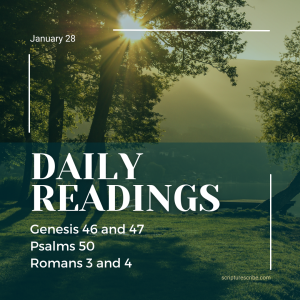
Genesis 46 tells of the arrival Jacob’s family’s in Egypt and gives their names and number – 66 persons who came from Israel’s procreation. Together with Israel and his 3 of his 4 wives 70 people in all came into Egypt. The chapter concludes with Israel and Joseph being joyfully reunited. Chapter 47 tells of their presentation to Pharaoh – in particular Israel’s words of blessing upon Pharaoh. Pharaoh invites them to settle in Goshen and supervise his own livestock herds. Israel told Pharaoh that his family have been sojourners. Pharaoh responded in generously allocating land in Goshen – the territory of his favoured priests. Verses 13-26 describe Joseph’s wise dealings with the Egyptians during the last 5 years of the famine. By his just actions he acquired most of the land and labour in Egypt, except for the priestly lands. Verses 27-31 tell of Israel’s family settling in Egypt and Jacob’s (Israel’s) death aged 147 years. Before his death Israel gave charge faithfully to Joseph that upon dying Israel would be buried in the Promised Land (verse 31 compare Hebrews 11 verses 21-22). One reason that the Genesis record devotes so many chapters to the life of Joseph, Saviour of his brethren and the world, is to help us appreciate the work of reconciliation that our Lord will consummate with his brethren, the Jews. Christ will “speak comfortably” to his people: Hosea 2:14. The emotions of our Lord and his people in the future are beautifully depicted in the scene of reconciliation portrayed in these chapters in Genesis.
Psalm 50 is a Psalm of Asaph, who was the recorder (or secretary) at the time of David’s kingship over all Israel. He rejoices in the fact that God Himself is the Judge. See the reverence for the Almighty Asaph has in the use of many titles for his Sovereign in verse 1. The earth is commanded to listen to God, who shines forth from the glory of His future sanctuary in Zion (the blessed Jerusalem of the Kingdom Age). The LORD will come with a terrifying vengeance. The heavens and the earth are His witnesses. His faithful saints will be there assisting in the establishing of God’s authority. By accepting His Son, the Lord Jesus Christ, through belief of the Truth and baptism; they have become His Covenant people. He judges His people in an incontestable way, since He is God. He doesn’t need either their sacrifices, or offerings, since every living creature belongs to the Creator. He doesn’t negotiate with lowly humans. There is absolutely nothing that we can give Him to atone for our sins. But, there is something that we can give to Him – full hearted thanksgiving. One writer, I Collier, in a poem in his book “Conviction and Conduct” wrote, “Give God Thy heart, tis all that He doth ask”. Those who humbly submit to Him will be delivered out of their troubles. By contrast He scorns the wicked by telling them that it will be useless to hypothetically call upon Him. He has not judged them yet; but will surely do so soon. The psalm concludes in verse 23. Slowly read these words aloud and contemplate what they are teaching.
Romans 3 turns attention to the Jewish people who were agreeing with every word Paul had uttered of the depravity among the Gentiles. They, too, were without excuse as they had the Word of God in their midst and yet were just as corrupt. From verses 9-20 Paul advances seven Scriptures supporting this. Then from verses 21-31 he proves that there is only one righteousness, and that on the basis of belief. What is required is a submission to the only way of declaring us to be right with God. This includes a confession that human beings are rightly related to death as we are incurably sinful. Additionally we confess that our Potentate only is righteous and strengthened His Son to accomplish what was humanly impossible. On the basis of the acceptance of these truths and our identification with the Lord Jesus Christ in whom they have been outworked forgiveness of sins is provided.Chapter 4 illustrates that through the lives of David and Abraham there is absolutely nothing we can do to be saved by works ie our own merits. God’s condition for forgiveness involves our acceptance of this truth and confession of our failures if we are to receive the blessings of forgiveness and to be inheritors of the promised Kingdom that will be, as verse 13 indicated, international. What is recorded was not for the sakes of those in the recorded Scriptures, but indeed for our sakes.
Penned by Warwick Rosser and his team, produced by Christadelphianvideo.org